
It only took a Chinese teenage prodigy to disprove quantum computing, the West is in "crickets" mode
Just another financial bubble for functional illiterate billionaires

Quantum advantage was supposed to be the ultimate proof that quantum machines could revolutionize global commerce, but 18-year-old Ewin Tang had other plans. In 2018, she presented a classical algoQrithm that matched the speed of a billion-dollar quantum promise, effectively "dequantizing" one of the industry's most cited commercial use cases. In this video, we go inside the Berkeley seminar room where Tang challenged elite physicists and computer scientists with her homework—an assignment that backfired in the best way possible.
To understand the magnitude of what happened, we look at the "fever dream" of the late 2010s. Billions of dollars were flowing into quantum computing based on the promise of exponential speedups in practical tasks like recommendation systems.
The industry relied on a 2016 paper by Kerenidis and Prakash, which claimed a quantum algorithm could sample data matrices exponentially faster than any normal computer. However, Ewin Tang discovered that the quantum "win" was based on a specific way of accessing data. By giving a classical computer a similar "fast pass" for data access (known as L2 norm sampling), she proved that a regular computer could theoretically achieve the same scaling performance.
5. Why do things exist? Because INTERACTIVITY

Nothing that doesn't create or respond to a difference of potential can be said to exist. This is not metaphor, this is not philosophy. This is ontological filtration. A metaphysical sieve that sorts signal from void, being from hallucination.
And when we weren’t even looking for it, funnily enough, we’ve also got backed by a channel called Asian Dad Energy. Energy spectrum coverage: full.
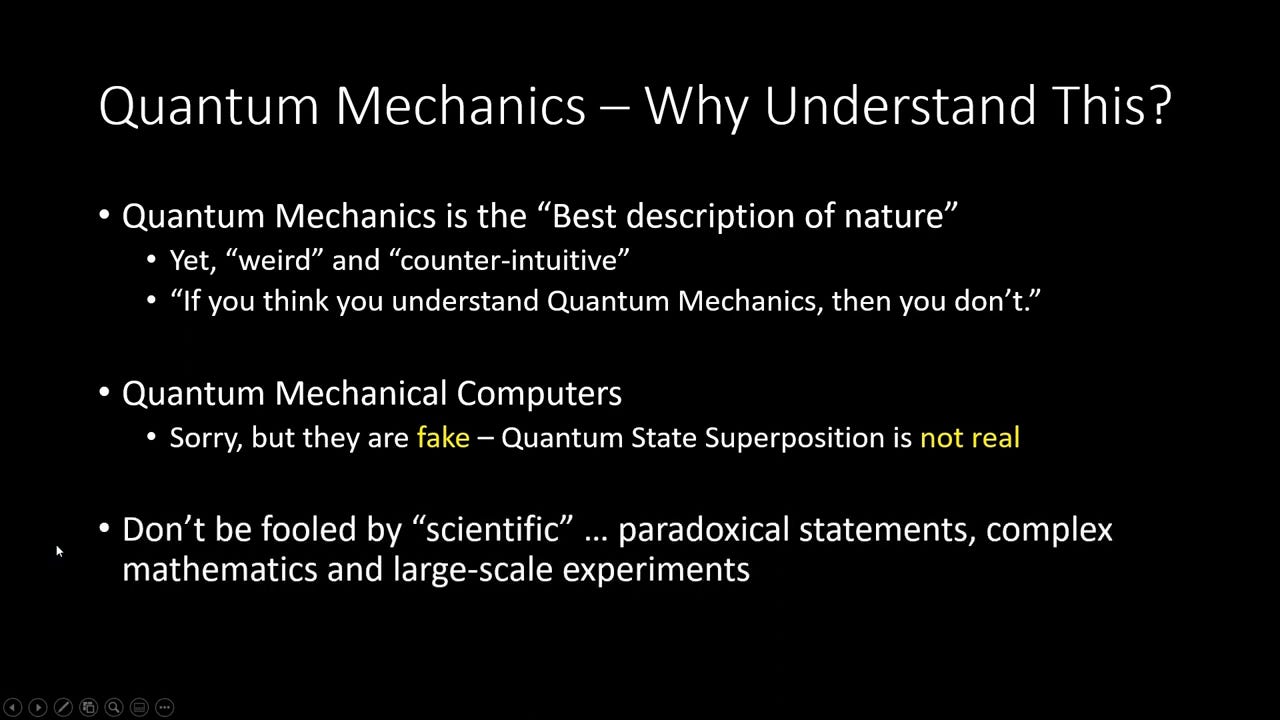
Quantum computing is BS because everything Quantum is nonsensical quackery for illiterates
LATER UPDATE: THE VILLAGE IDIOT HAS JUST ENTERED THE CHAT


